Gifts of hope and independence: Christmas care with lasting impact
‘A hand up, not a handout’, may be a familiar phrase, but at Northside Salvation Army in Geelong, Victoria, it is an approach that changes lives. Offering Christmas help and hope without creating dependency is a fine balance. But for the Northside team, it is essential to helping individuals and families who may be struggling, to regain stability and build independence.
Last Christmas, supported by local churches and community groups, the Northside Salvation Army distributed more than 400 hampers (plus another 100 to a local Salvation Army homelessness service), more than 400 toys and countless vouchers, while also hosting a community Christmas lunch. But the mission went beyond meeting immediate needs.
The goal was to equip people with the tools, support and confidence to face future challenges, including the ability to provide their own Christmas in years to come.
Reality of a hand-up, not handout
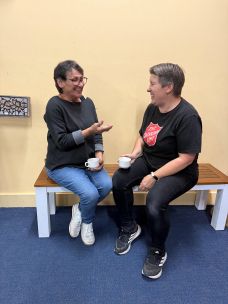 For corps officer (manager) Joy Cassidy, Christmas is about much more than giving. “It’s about building resilience and independence, and creating deeper connections to community,” she says.
The focus of support goes beyond immediate Christmas needs, building long-term independence and resilience. This involves identifying needs, building on strengths and connecting people to ongoing support.
“Christmas is just one day out of 365, and people don’t just experience a crisis at Christmas. They have a crisis that affects Christmas,” Joy says. “Christmas is not usually the crisis.”
If you are going through hard times, the Salvos can help bring stability and hope this Christmas
Several years ago, Joy and her team redefined how they provided Christmas support for the 15 different language groups they connect with.
Rather than simply distributing the same ratio of toys, food and vouchers to each person or family for Christmas, they began conducting detailed interviews to assess individual needs and capabilities, ensuring deeper care that fosters long-term independence rather than dependence.
Through in-depth interviews, support to connect with community groups, referrals to services including The Salvation Army’s Moneycare free financial counselling and support from a range of community organisations that work as an effective network, Northside Salvos strives to build capacity and confidence.
“If we are creating a culture of ‘I want’ where people come only expecting to receive, then we haven’t done our job properly,” Joy says. “Instead, we ask, ‘What can you manage?’ and ‘Where do you need support?’. This way, we are equipping people to move forward with confidence and independence.”
Each person’s needs and challenges are different, says Joy, but the goal remains the same: to empower and equip.
As a result of intentional, focused care and independence-building, less than half of those seeking Christmas assistance return the following year (although many stay connected to the Northside Salvos in other ways).
Building connection and community in Geelong
Salvos Northside also provides Doorways emergency relief and case management, homelessness and housing support, as well as meals, clothing and other essentials for those experiencing homelessness. A community centre open every weekday offers a safe space for connection, including for those with complex mental health challenges. A church service runs weekly, as well as faith-based groups through the week.
“This is all about community and capacity,” Joy says. “God came as Emmanuel — God with us — and he calls us to be with each other, to build community.”
Joy says it takes time and resources to interview every person who registers for Christmas care, but as well as determining need, it also serves to begin to address underlying issues.
“We’ve become really intentional in asking the right questions — even simple ones, like ‘How many adults live in your house?’. We found that many households have more than just the parents as adults, yet the parents are covering all expenses while their adult children contribute nothing. In these cases, there is often capacity to manage as a combined household, but financial responsibility needs to be addressed.”
Another simple and effective tool, Joy says, is encouraging all who come in to open a ‘Christmas Club’ account with a local bank to save even a little for the following Christmas. Joy says a high percentage of those who come in for Christmas care have subsequently done so, to prepare the following year.
Help and hope through Christmas connections
The Northside team sees positive outcomes often.
Lena* was one of hundreds who sought help last Christmas.
In her 70s, living alone and struggling with English, she had always managed on her pension — until the cost-of-living crisis made ends impossible to meet. When asked for her pension card as identification, Lena was unsure if she had one.
After some searching, it was found among her belongings, but with her limited English, she had never understood its purpose. The team explained that her pension card entitled her to discounts on utilities, transport and medications, and helped her immediately apply for some of those discounts. With heartfelt thanks, she said that if she had known earlier, she wouldn’t have ever needed help.
Another young couple arrived for Christmas assistance with a $600 debt they couldn’t clear. They were immediately referred to a Salvation Army Moneycare financial counsellor, who, because of their particular circumstances, was able to have the debt waived on the spot.
Encouraging independence
“We don’t want to build a culture of dependence,” Joy says. “Rather, we are fostering a culture of independence. I say to the team all the time — if we are doing our job properly, we are working our way out of a job, because we are empowering the community enough that they won’t need us.
“We are part of something bigger. We are not just building our community — we are strengthening the broader community.”
For Joy, this work is deeply personal.
“I didn’t grow up in the Salvation Army, but I grew up in a Christian home and became a Christian when I was 18. I always had a heart for those who were really struggling. I trained as a preschool mothercraft nurse. I loved getting alongside parents, encouraging them to be the best they could be and to bring out the best in their kids,” she explains.
“But there was a shift when I discovered the story of [Salvation Army founders] William and Catherine Booth and their vision for a church that worshipped God and also met people’s needs in practical ways. The Salvation Army gave me an opportunity to live out my faith in action.”
Joy says passing on hope to others is her passion.
“There are so many people who feel that life is hopeless, and therefore that they are hopeless. But God says, ‘The situation might look hopeless, but you are not hopeless. You have the capacity to get through this’. Most of the time, [God] takes us through difficult situations. There are bumps along the way, but we learn from them and build resilience for the next time we face challenges.
“For me and our team, there are so many opportunities to encourage people to choose hope, to choose life, to choose light — to see good in the world. And even if every person who walks in our door leaves feeling [genuinely] seen, heard and valued, then we have done our job.”
*True story, with name changed for privacy.