

Dealing with debt
Steps to living debt-free
The first step is often clearing debts you already have - for example credit cards, personal loans, Buy Now Pay Later, utilities, fines, school fees and unpaid taxes - debts you might have been hiding or avoiding. Moneycare financial counsellors can help you with this.
Sometimes you are managing debt just fine, but then you have a change in circumstances like a loss of income or an unexpected expense and it can get in top of you.
We know that debt can affect relationships, health, feelings of self worth, stress and sleep patterns.
Debt test activity
If you answered yes to any of the following below, you probably suffer from some financial stress. Don't ignore the situation, take action today.

Yes / No
I spend more than I earn each month and regularly dip into savings.

Yes / No
I put day-to-day expenses on credit cards (or using other types of debt products) because I have no money.

Yes / No
I'm only able to afford the minimum payment on my monthly credit card bill.

Yes / No
i'm unprepared for emergency expenses like car repairs or an unexpected medical bill.

Yes / No
I'm feeling stressed and avoiding opening the mail or responding to people chasing payments.
Did you know?
We know from research and from the thousands of people who seek support from Moneycare each year that there are two really important actions in staying well financially:
- Actively saving
- Not borrowing for everyday expenses
Use this table as a guide and list your debt for each row. For each one write down:
- How much you owe in the "balance" column
- Your interest rate (if known)
- The minimum payment (if known)
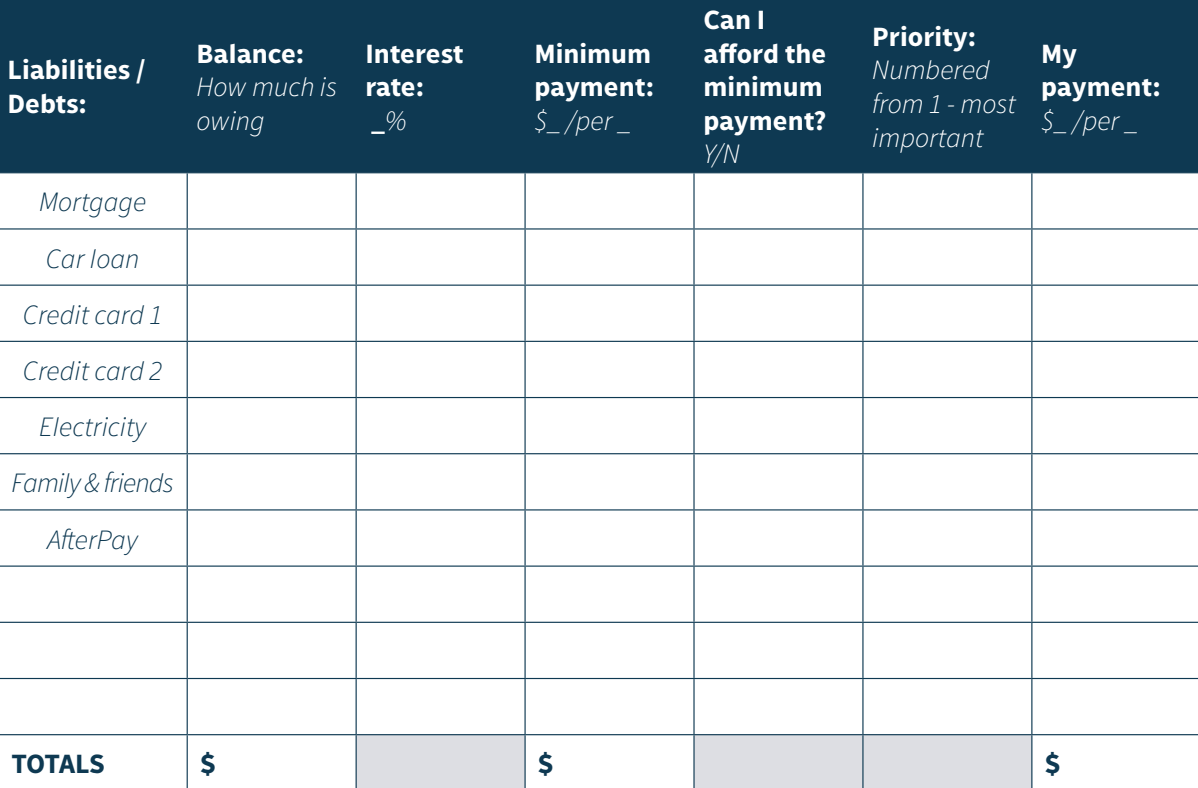
The table above features a blank table titled Liabilities / Debts designed for tracking and prioritizing debt payments.
- Columns (left to right): Liabilities / Debts, Balance (How much is owing), Interest rate (_%), Minimum payment ($_ / per_), Can I afford the minimum payment? (Y/N), Priority (Numbered from 1 - most important), and My payment ($_ / per_).
- Pre-filled debt categories (Rows 1–7): Mortgage, Car loan, Credit card 1, Credit card 2, Electricity, Family & friends, and AfterPay.
- Blank rows (Rows 8–10): Three empty rows provided for custom liabilities.
- Totals row (Bottom): Prompts for sum totals under Balance, Minimum payment, and My payment, with non-applicable fields shaded in grey.
Can you afford to make the minimum repayment on each one? If you can't, get in touch with Moneycare.
Priortise your debts
Some debts are more critical than others, and some ongoing expenses are essential.
- A roof over your head, food on the table and essential health items need to be covered.
- Electricity, gas, phone, internet, water, rates and insurance are also important.
- Secured debts, like a mortgage or a car loan need to be maintained.
- Also consider:
- Are you in arrears (overdue) in making a payment?
- Is there legal action in process for an amount you owe?