

Credit cards
With nearly two million Australians struggling to repay their credit card debt, we think credit cards should come with a warning label.
What we know
Credit cards are the most common debt that people connecting with Moneycare need help with. In 2018, 49% of people had at least one credit card, and for half of those people, the debt was more than $10,000.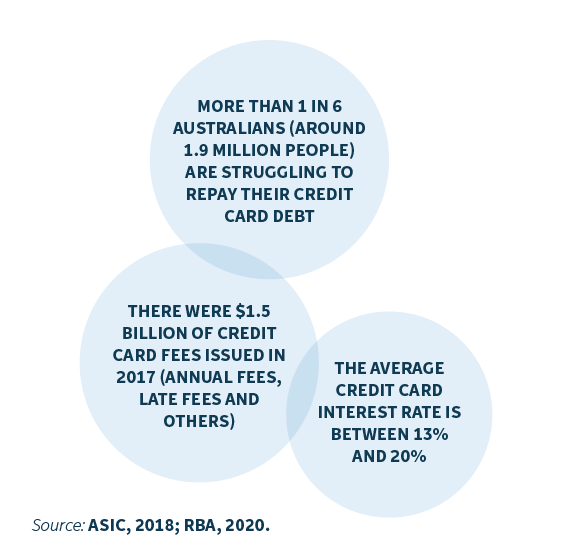
Remember!
With a credit card, it’s easy to spend and difficult to repay.
7 reasons not to get a credit card
1. It can create a habit of spending money you don’t have
2. It increases how much you spend
3. It reduces the control you have of your financial situation
4. It makes you less prepared for unexpected expenses or other life events
5. Missing payments will impact your financial institution’s profile of you and potentially your credit rating
6. You’ll be charged really high interest if you miss a payment
7. You don’t need one!
If you don’t need to borrow, you don’t need a credit card.
And 3 good reasons people choose to get one:
1. Security: You get cover if someone uses your card without your permission to make purchases.
2. Purchase protection: Some credit cards come with purchase protection, allowing you to make insurance claims for items purchased with your card that are lost or damaged (usually within 90 days from purchase).
3. Convenience: Credit cards are accepted just about anywhere, so they’re good for online shopping and can be used for overseas travel.
Why do we spend more with credit cards?
When we pay electronically, the pain of paying is reduced as we don’t physically see our money disappearing. ‘Pain of paying’ describes the emotional distress we experience when money is spent.
With credit cards, the pain is further eased by the time gap between when the credit card is used to make a purchase and when the bill has to be paid. Also, the bill is a mixture of different purchases so by the time it is actually paid, we don’t attribute the payment to any one particular purchase.
It’s no wonder that studies consistently show that use of credit cards increases spending – it’s less painful in the moment.
OK, you've already got one...
How do you use it?
- Only use it for planned purchases that you can afford.
- Pay the balance in full and on time every month.
- Check your statement and contact your credit provider if there’s a charge you didn’t make.
How do you pay it off?
- If you can’t pay the balance in full at the end of the month, stop using the card.
- Contact your credit card provider to discuss hardship options. We can help if you’re unsure.
- Also check out our advice on Dealing with Debt.
How do you get rid of it?
- Work out how much you can afford to pay off each month.
- Use the Moneysmart calculator to help you work out how long it will take to pay off.
- Set up a direct transfer to your credit card each month until it’s paid.
- Cut it up! This removes the temptation to use it in the future.
- Stop automatic payments being charged to the card.
- Stop using the card for any purchases.
What about reward points?
Reward programs on credit cards are a marketing exercise for the financial institution. They might work for large, frequent purchases but make sure that they don’t actually lead to you spending more! Also, all your purchasing information will be used to target marketing at you.
What about balance free transfers and other offers?
Lenders look to catch and keep you with offers of low or no interest if you switch to their product, either with a balance transfer or a loan that may
consolidate a few debts. For these to work, you need to be really disciplined in paying them off. Also be wary of fees and charges.

Debt trap risk
An ASIC report from 2018 found that nearly one in three people actually increased their total debt after doing a balance transfer. This is called a ‘debt trap’ risk, where people take on one debt to cover another one, ending up stuck in a cycle.
Activity
You do the (repayment) maths.
Look at your credit card statement (if you have one):
- How would you feel if you didn’t have credit card debt?
- How much interest will you save by repaying your credit card faster?
- How much extra will you need to repay each month to pay your
card off in two years?