

1. Money wellbeing
Are you good with money?
Chances are what comes to mind in response to this question are thoughts and images like:
- Managing money is hard and scary
- I don’t have enough money
- I’m not an expert
- I’ve made too many mistakes with my money
These stories you tell yourself (and others) about money can powerfully shape your life. This is why it’s important to understand what influences your ideas around money.
If you only look at what society declares, you might believe success is solely measured by how much money, possessions and experiences you have. But there is another way of achieving money wellbeing that has nothing do with society’s version of success.
This starts by acknowledging what you’re already doing well with your money and opens a pathway for positive action.
Three steps to get you started
Activity
How did you go? What did you notice?
Suggestions below...

Utility bills
I have a plan for paying my bills.

Tax
My tax return is up-to-date.

Superannuation
I know where my super is.

Stability
I always provide for my family.
Finding your currency
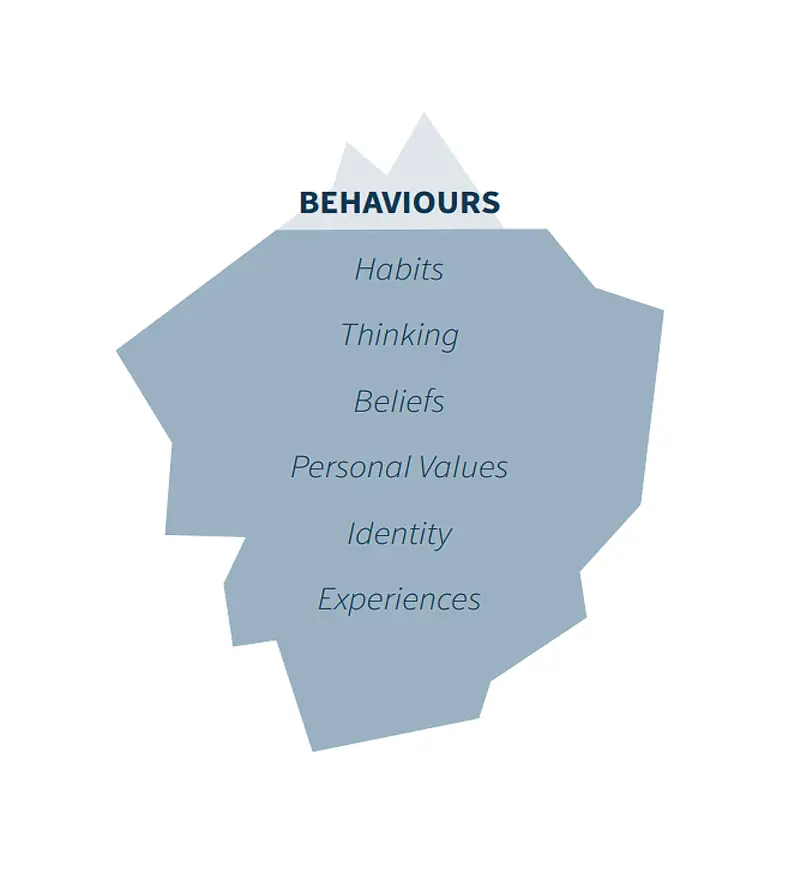
Your money story
Our past experiences with money affect how we manage our money today. Our “money story” is made up of our personal experiences, family history and current situation.
We all have our own story.
This iceberg diagram shows how the things we do and others see are driven by our deeper attitudes, values and life experiences.
Your values
Knowing your values and aligning them with your financial decisions is part of the road map to help you live well.
Completing your money story may have helped you understand why you spend the way you do, or why you find it hard to follow through with your good intentions — but your past experiences with money don’t need to control your future. If you take time to explore your values, you can determine what is really important to you when it comes to money.
Your values are the principles that guide your life and who you are. It’s easy to confuse goals with values. A helpful analogy is thinking of life like a map:
- Destinations = your goals
- Compass directions = your values
Your values help you navigate life’s experiences and determine if you’re moving in the right direction towards your goals. They help you make key decisions, stay motivated and keep grounded in times of distress.
Why values?
The world will try to tell you what’s important with advertisements in magazines, television and on your social media feeds. The key is to stop and listen to your own inner voice telling you what you really value. As author of The Happiness Trap, Russ Harris says, “true success is living by your values.”
Discovering your values
There are many ways to discover your values. Everyone will have different priorities, and these might change over time. For example, you might value relaxation and time with family. Or you might value working hard and being prudent with money.
Five steps
Allow plenty of time to do this activity, following through each step.
Step 1. Reflect
Step 2. Values shortlist
Write down the values that are important to you now.
| For example | |||
| Abundance | Designing | Humility | Purpose |
| Acceptance | Diversity | Humour | Recognition |
| Achievement | Duty | Imagination | Reconciliation |
| Activism | Emotional intelligence | Independence | Relationships |
| Adventure | Empathy | Influence | Reliability |
| Ambition | Equality | Innovation | Respect |
| Attention to detail | Excitement | Inspiring others | Risk taking |
| Authenticity | Experimentation | Integrity | Safety and security |
| Authority | Fairness | Intelligence | Self-care |
| Balance | Faithfulness | Kindness | Self-control |
| Beauty | Family | Leadership | Self-respect |
| Belonging | Financial security | Learning | Sensuality |
| Challenging myself | Fitness | Leisure | Service |
| Change and variety | Flexibility | Love for others | Simplicity |
| Collaboration | Food | Mastery | Solitude |
| Comfort | Forgiveness | Mindfulness | Spirituality |
| Commitment | Freedom | Music and art | Spontaneity |
| Community | Friendship | Organisation and order | Stability |
| Compassion | Fun | Peace | Story telling |
| Competence | Generosity | Persistence | Supporting others |
| Competition | Genuineness | Personal growth | Taking responsibility |
| Connecting with nature | Happiness | Physical challenge | Teaching others |
| Connecting with others | Harmony | Play | Tolerance |
| Cooperation | Health | Pleasure | Tradition |
| Courage | Helping others | Power | Trust |
| Creativity | Honesty | Problem solving | Wealth |
| Curiosity | Honour | Professionalism | Wonder and awe |
Step 3. Key values
Now select which of the values stand out for you most and write down why?
Step 4. Check in
Look at your list of values - what do you notice? They are yours, so be proud of them! Your values are fluid and will change over time.
Step 5. Make them memorable
You’ve done the hard part, now it’s about creating reminders of your values in places you’ll see them. You could do this by:
- Writing them on a stone and carrying it in your pocket or putting it on the windowsill
- Drawing them on your own “coat of arms”
- Adding them into your phone and setting reminders throughout the week
- Writing them on cards and putting them somewhere you’ll regularly see them - like your bathroom mirror or car dashboard.
Money and values
Aligning your personal values with your financial decisions improves your chances of gaining peace and satisfaction.
Complete the following sentences for purchases or financial decisions you’ve made recently — either one you were happy with or one you would do differently next time.
Example: Positive purchase
This week I bought a gift for a friend and I was really satisfied about it because what I gave was thoughtful and a special way to acknowledge our friendship.
Your turn
This week I [made a purchase or financial decision] and I was [how did you feel] about it because [why].

Where to next?
Does the way you spend your time and money match up with what you said was most important?
This may be the first time you have ever thought about this, and the process may be painful. Begin noticing moments when your time and money don’t align with your values.
There will always be changes you can make to better align your behaviours with your values. And your values and priorities will change over time too.
Your conversations
Engaging in money conversations is an important financial skill for life.
The conversation you have with yourself
The first and most important conversation you have is the one that goes on inside your own head! The voice can say positive things, like: “Ok this looks tricky but I’m a good problem solver so I’ll find a solution.” Or negative things, like: “I’m hopeless, I always mess up.” Your self-talk is incrediably powerful. It can help you, or sabotage you.
The conversations with others
Let’s face it: talking about money is tough! A recent survey found that nearly half of all Australians find it a difficult conversation to have — people feel ashamed they don’t have enough money, or they’re worried about being judged for having too much compared to others.
The hardest part is often knowing how to start a difficult money conversation. Scott Pape’s book The Barefoot Investor has been an Aussie bestseller for years, and one of its main messages is simply to start talking about money. Set aside a regular, intentional time to talk to your partner or loved ones.
And above all
Activity
Partners and loved ones
Having the skills to navigate conversations about money within your own family is really important, because families are always interconnected.
Within a family money can be shared — for example a couple might pool their resources, or a parent might still financially support an adult child. Or there could be an expectation that money is shared amongst the extended family — perhaps regularly, or in times of trouble. So, it’s crucial that you know how to talk about money.
We know that silence about personal finances can be damaging. Silence can be a barrier that stands in the way of real authentic relationships with those you love.
When you approach a conversation about money, the first thing to be aware of is that everyone has different ways of thinking about money — and you’ll have a different money story to your partner.
Talking about money can bring up many different emotions for different people — worry, anger, guilt or joy. It can put someone on the defensive straight away.
Your life
What do you want to do to create a life of flourishing?
Everyone has a money story
You have a set of values that are uniquely yours. You are building your tool kit to enjoy life to the full.
Bill of rights
A bill of rights is a declaration of individual rights and freedoms.
Here are seven rights you can claim as your own to see your finances (and your life) flourish! You may wish to add more.
- I have the right to seek help.
- I have the right to not have it all figured out today.
- I have the right to set my own priorities.
- I have the right to feel my emotions.
- I have the right to say “I don’t know”.
- I have the right to make mistakes.
- I have the right to rest and feel satisfied.